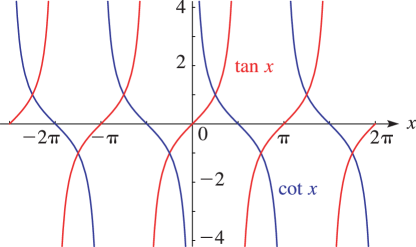
a. tangent
b. cotangent
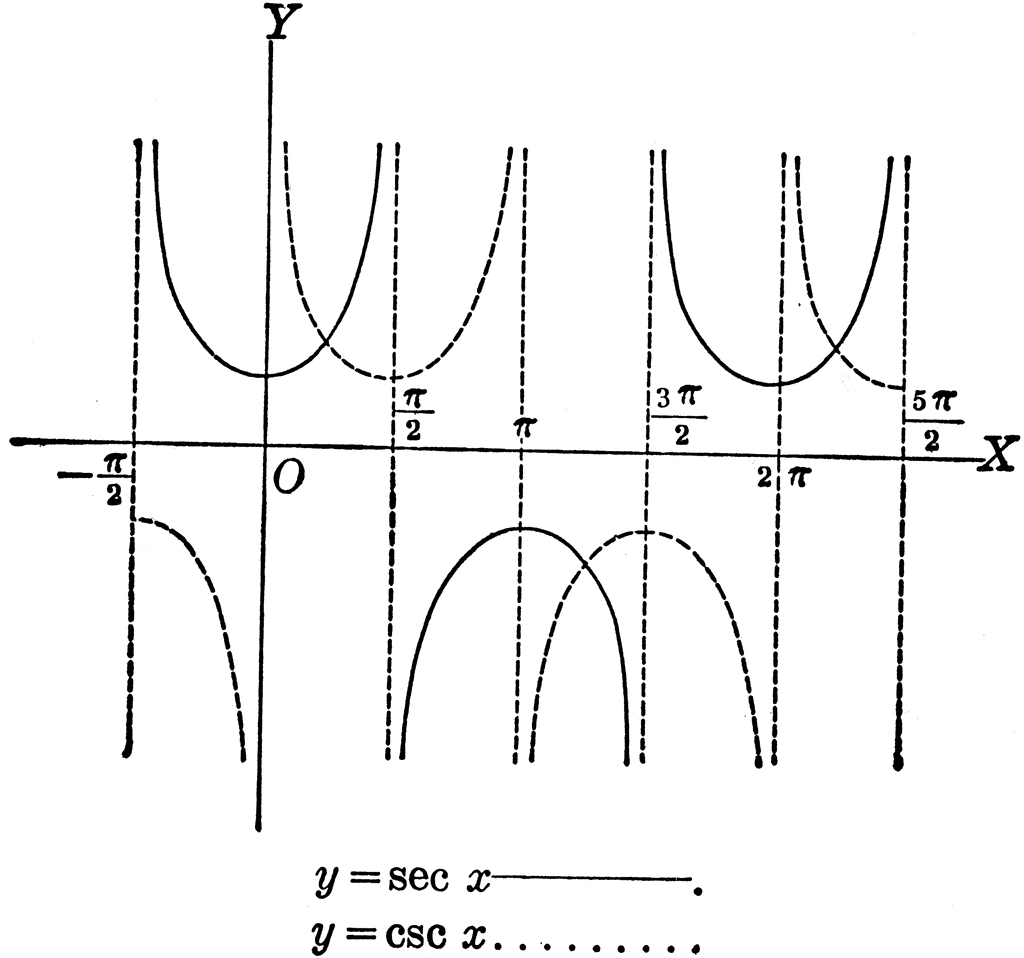
c. secant
d. cosecant
What is this
concept about?
This concept
explains how sine and cosine are related to making the graph of the other trig
functions. Ratio and reciprocal identities are used in order to understand this
concept.
What the
viewer needs to pay close attention to in order to understand the concept?
We need to
pay close attention to the pattern of the signs in the graph. There is a trick
that involves the signs to know whether the drawings on the graphs are correct for cotangent and tangent. For sin and cos the graph will lie in the corresponding ratios place. For example sin will stay with csc and cos will stay with sec.
Sine and Cosine are used to draw the other trig ratio graphs because they use the ratio identities and reciprocal identities to know the asymptotes to draw there graph.
Tangent/Cotangent
The signs we
are using are of sine and cosine of each quadrant:
Quadrant 1- Positive
÷ positive =positive
Tan,Cot,Sin,Cos
fall in positive.
Quadrant 2- Negative
÷ positive=negative
Sin positive; Cos,Tan,Cot negative
Quadrant 3-
Negative ÷ negative= positive
Sin and Cos
negative; Tan and Cot positive
Quadrant 4-
Negative ÷positive=negative
Cos
positive; Sin negative, Tan and Cot negative
The trick was used above. What it is is that the division we do from sin and cos gives us the sign (positive or negative) in which the tangent and cotangent lie in.

The picture above shows sin.cos,tan.cot being graphed. You can see the trick visually on the graph.
CSC/SEC
The reciprocal
will lie in the same position to its corresponding trig ratio.
Quadrant 1-
Sin,Cos,Csc,Sec
fall in positive
Quadrant 2-
Sin positive Csc positive; Cos, Sec negative
Quadrant 3-
Sin,Cos,Csc,Sec negative
Quadrant 4-
Cos,Sec
positive,Sin, Csc negative