1. Explain in detail where the formula for the difference quotient comes from now that you know! Include all appropriate terminology(secant line,tangent line, h/delta (∆) X.)
Background The ∆X is the same as H. ∆X=H Wherever ∆X is it is just taking the place of the H. This triangle sign stands for change ∆, when paired with X (∆X) we know it as Delta X.
Deriving the Difference quotient involves the slope formula and two points that make a tangent and the secant line.
First off in the graph seen below we see two points on the graph. It shows how the difference quotient variables are seen on a graph.
- The black point forms a tangent line. It makes a tangent line because it touches the graph once. This point will be known as our X.
 |
| http://www.teacherschoice.com.au/images/derivative_secant_1.gif |
-The picture above demonstrates a red dot which is our secant line. The secant line crosses two points, the black and the red dots. This point is labeled as X+ ∆ X(H). This point is labeled as X + ∆ X(H) because the distance between the two points are ∆ X(H), therefore we add the ∆X(H) to the X and that is how it becomes X+ ∆ X(H).
After we organize our X and Y points to plug into our slope formula. As seen in the picture shown previously the points we will be using are (x(X1),f(x)(Y1),(x+h(X2),f(x+h)(Y2).
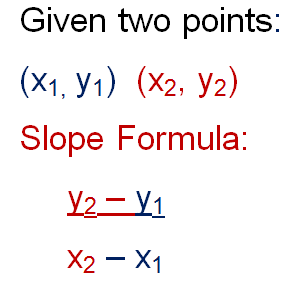
This is where we use the slope formula to form our difference quotient. The slope formula is Y2-Y1/X2-X1:
 |
| http://www.algebra-class.com/image-files/slope-formula-2.gif |
As we see in the image below, in the denominator the X's cancel leaving us with just ∆ X(H). After canceling the

This video shows the process visually of how to derive the Difference Quotient. It begins with showing the difference quotient from the graph and moving in the using the slope formula to solve the difference quotient. Hope you enjoy!!
http://www.youtube.com/watch?v=XA0fZh8cXV8

No comments:
Post a Comment