Create your own Playlist on MentorMob!
Sunday, February 24, 2013

Thursday, February 21, 2013
Monday, February 11, 2013
Unit N Concept 7: Deriving the Unit Circle
 |
| Figure 10.3 |

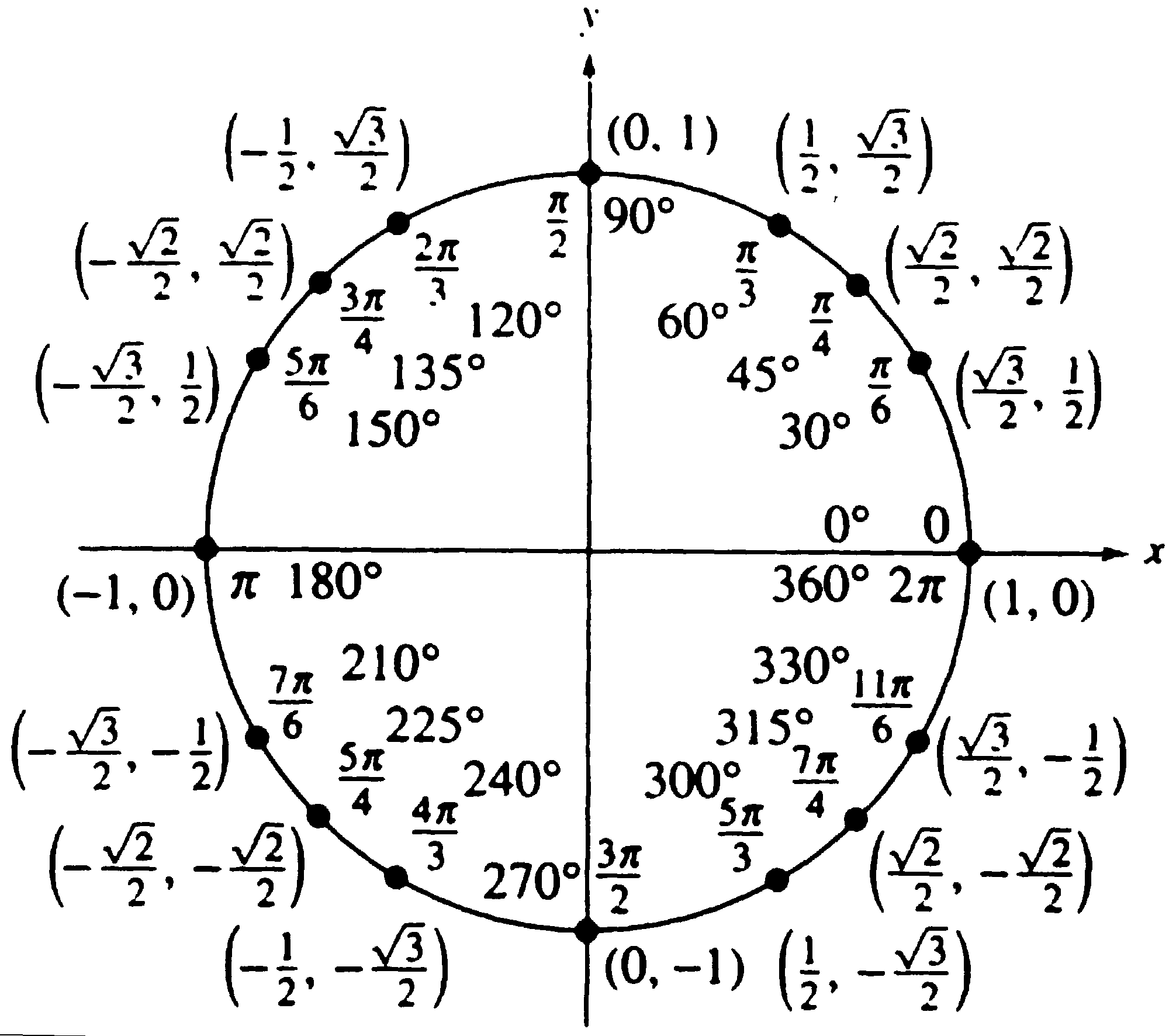
The 30°, 60°, 90° triangle and the 45°, 45°, 90°
triangle comes from the unit circle because they are within it. We get degrees
and the X and Y axis from the unit circle. As you can see in the pictures above
it is showing how the 30° angle forms a triangle with the degrees 30°, 60°, 90°
and the 45°, 45°, 90° degree angle is also taken from the unit circle at the
45° angle from the unit circle. Now figure 10.12(above) shows the 30° triangle
drawn, we use it’s ordered pair from the unit circle to label the triangles x
axis and y axis. Since the ordered pair is (√3/2, 1/2). The x of the triangle
will be √3/2, and the y is 1/2. For the hypotenuse it will equal 1(the radius
of unit circle is 1.) This same process goes with the 45° angle triangle (figure 10.3).
The ordered pairs are (√2/2, √2/2). They will be the x and the y of the triangle
and the hypotenuse will equal 1.
Friday, February 1, 2013
Real Life Conic Sections
1. What is the mathematical definition of this conic section and how does that definition play a role in the properties of the conic section and how it is shaped or formed?
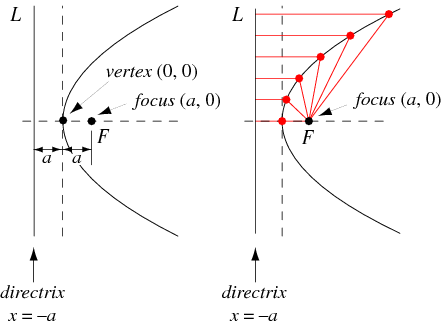
The mathematical definition is the vertex to the directrix and the focus to the vertex are equivalent measurements. This definition pretty much explains how any point on a parabola is the same distance from the directrix as it is from the focus. Now figuring out the shape of the parabola depends on the P. The smaller the P is the smaller the U shaped will be whereas the bigger the P the bigger shaped U it will be.
2. How does the focus (or foci) affect the shape of the conic section?
For a parabola the focus can help with determining the part where the parabola opens( so if the focus isn't between the U of the parabola then there's a problem). The "P" takes a very very important role in parabolas because it determines the distance between the focus to vertex and vertex to directrix.
 3. How do the properties of this conic section apply in real life?
 Parabolas are a shape that is thought to be hard to find in the real life, but in reality we use or see it often. For example car lights, St. Louise arc and the satellites for TVs are just some items. One example of a real life parabola is the Golden Gate Bridge. As seen in the picture it has a U shaped. The deck of the bridge is the vertex and the horizontal road can be seen as the directrix. Since the U is wide the P is most likely to be a large number.
Citation:
The parabola was pasted from: https://www.google.com/url?sa=i&rct=j&q=&esrc=s&source=images&cd=&cad=rja&docid=Okt3i3mN7ufbqM&tbnid=iN3SK_14JwyBgM:&ved=0CAUQjRw&url=http%3A%2F%2Fmathworld.wolfram.com%2FParabola.html&ei=4VAMUdWwAqW22gWup4H4DQ&bvm=bv.41867550,d.b2I&psig=AFQjCNHt1UyzVkx-Eg48USsXMnkxkZci7g&ust=1359847363674031
The video was pasted from:
http://www.youtube.com/watch?v=cXOcBADMp6o
The picture of the Golden Gate Bridge:https://www.google.com/url?sa=i&rct=j&q=&esrc=s&source=images&cd=&cad=rja&docid=JxaiTC5auYoTiM&tbnid=HMFVcBC3xzGfNM:&ved=0CAUQjRw&url=http%3A%2F%2Fmathforum.org%2Fmathimages%2Findex.php%2FParabolic_Integration&ei=L1MMUZHlMOKE2wW-v4HAAg&bvm=bv.41867550,d.aWM&psig=AFQjCNF-iMVxE6EZ6P4HmgbL2ffAieNKhQ&ust=1359848584990104
Subscribe to:
Posts (Atom)